Is a Hammamet to Carthage day trip realistic in one day?
It is, as long as you accept that each stop gets one to two hours rather than a full day. Hammamet sits about an hour from Tunis on the A1 motorway, and Carthage and Sidi Bou Said are only 10 minutes apart along the coast. The driving adds up to roughly two and a half hours, which leaves around four and a half hours on foot.
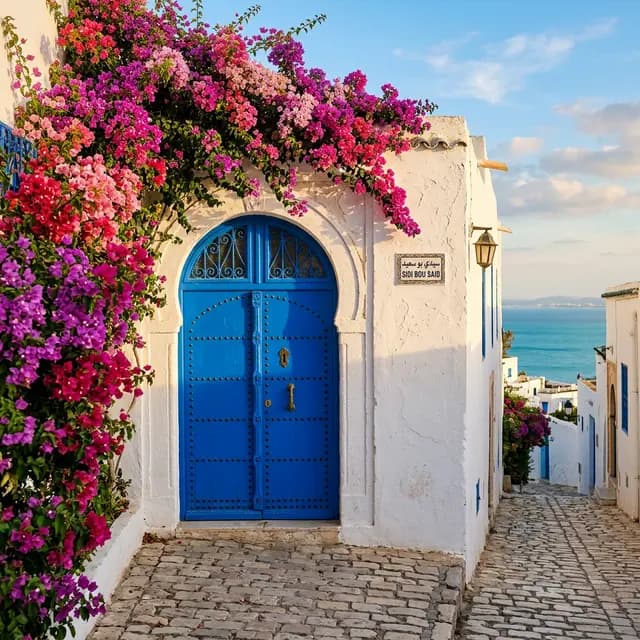
What makes or breaks the day is the order. Start in the medina while it is cool and the souks are opening, cross to Carthage for the ruins, and finish in Sidi Bou Said when the light softens. Do it the other way round and you arrive in the blue and white village at noon, with every coach from Tunis.
Hammamet to Carthage day trip: the hour-by-hour itinerary
This is the order and timing our drivers use on the Carthage and Sidi Bou Said tour, and it works just as well if you go on your own. Times move by half an hour either way with traffic at the entrance to Tunis.
| Time | Stop | What you do |
|---|---|---|
| 8:00 or 9:00 | Pickup in Hammamet | Collected at your hotel, Airbnb or address |
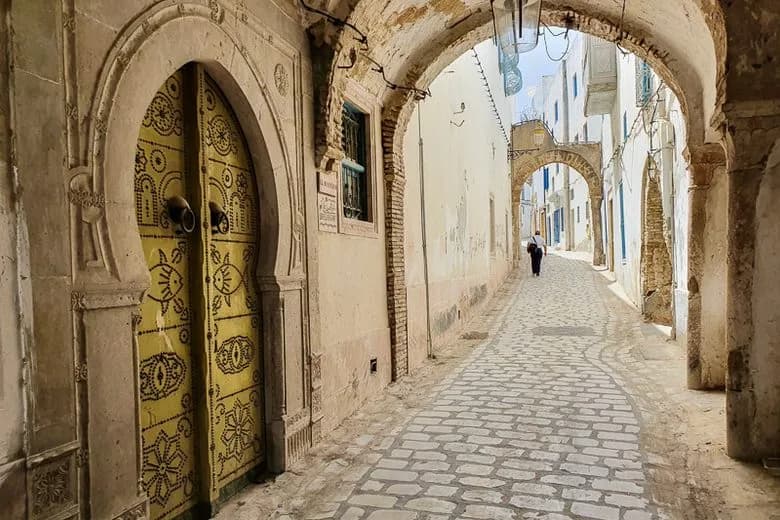
| About 9:00 | Medina of Tunis | About 1 hour on the A1, then 1.5 to 2 hours walking the souks to the Zitouna Mosque |
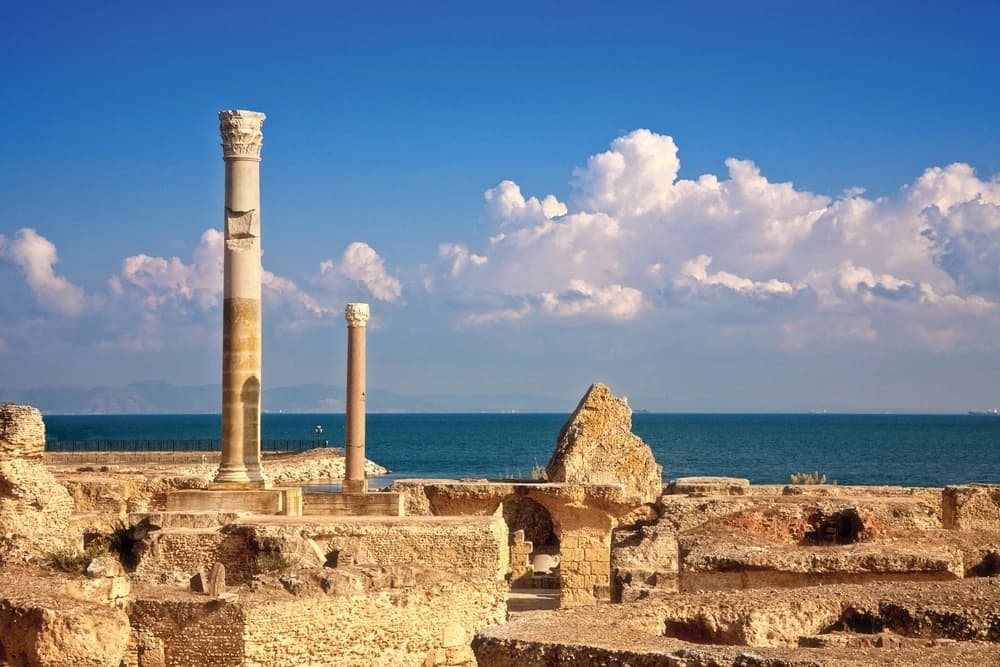
| Around 11:30 | Carthage | About 20 minutes to the coast. 45 minutes for a panoramic tour, or up to 1.5 hours inside the sites |
| Around 13:30 | Lunch | Carthage, La Marsa or Sidi Bou Said, your choice |
| Around 14:30 | Sidi Bou Said | About 10 minutes along the coast. 1 to 2 hours of lanes, cafés and views |
| Around 18:00 | Back in Hammamet | About 1 hour back to your door |
Why does this order work best?
The medina is at its best in the morning: shops are opening, deliveries are going in, and the narrow lanes are noticeably cooler than they will be at 15:00. Carthage is open ground with little shade, so a short midday visit is easier than a long one. Sidi Bou Said empties from around 16:00 when the coaches head back, which is exactly when you want to be there.
Can you add the Bardo Museum?
Only by giving something up. The Bardo needs about 1.5 to 2 hours, and it sits on the west side of Tunis while Carthage and Sidi Bou Said are to the north east. The usual swap is the Bardo instead of the medina, or the Bardo plus a quick panoramic tour of Carthage. If the Bardo matters most to you, message us before booking and ask how the day could be arranged.
How much are the entry fees in Carthage, the Bardo and the medina?
Budget about 12 TND per person for Carthage and around 13 TND if you add the Bardo, roughly €4 each. The medina of Tunis and Sidi Bou Said are free to walk. Tickets are paid in dinars at the gate, and cash is the safe choice.
| Site | Price per person | What it includes |
|---|---|---|
| Carthage archaeological site | 12 TND (about €4) | One ticket for every sector the same day: Antonine Baths, Byrsa Hill, the Tophet, the Roman villas |
| Bardo National Museum | Approx. 13 TND (about €4) | The museum's Roman mosaic collections. Usually closed on Mondays |
| Medina of Tunis | Free | The souks and lanes. The Zitouna Mosque is viewed from the entrance, never during prayer |
| Sidi Bou Said | Free | The village itself. Dar Ennejma Ezzahra palace charges a small entry, approx. 10 TND |
Keep your Carthage ticket in your pocket after the Antonine Baths. The same ticket is checked at every sector, and losing it means paying again. The Carthage site and the medina of Tunis are both UNESCO World Heritage sites; the UNESCO page for Carthage is a good ten-minute read before you go.
Organized tour, louage or private driver: which is best?
For two or more people, a private driver usually gives the best value for time; alone and on a tight budget, the louage is cheapest. A coach tour sits in between on price, but you follow its timetable and its shop stops.
| Option | Price (approx.) | Time on the road | Comfort | Flexibility | Best for |
|---|---|---|---|---|---|
| Excursion Hammamet private car | €80 (about 270 TND) per vehicle, 1 to 4 people | About 2.5 hours in total | Air-conditioned, door to door | High: you set the pace | Couples, families, small groups |
| Coach tour from a hotel rep | Typically €50 to €75 per adult | 3 to 4 hours with hotel pickups | Good, but shared | Low: fixed timetable | Solo travellers who want company |
| Louage + TGM train + taxis | Approx. 25 to 40 TND per person in transport | 4 to 5 hours with waits and changes | Basic, no air conditioning guaranteed | Medium | Budget solo travellers |
| Freelance taxi for the day | Approx. 250 to 350 TND per car, negotiated | About 2.5 hours | Varies with the car | High, if agreed in advance | People who like to negotiate |
Every group size and pickup city is priced on our Hammamet excursion prices page, and what to expect on a private excursion from Hammamet explains pickup, the driver and payment in detail.
How do you get from Hammamet to Tunis by louage?
Louage to Tunis
From the louage station in Hammamet to Tunis, approx. 6 to 8 TND and about 1 hour 15. The van leaves when all eight seats are full, so arrive before 8:00.
Walk or taxi to the medina
From the Tunis louage station, a short taxi ride takes you to Bab Bhar, the gate of the medina. Agree the meter before you set off.
TGM train to Carthage
From Tunis Marine station, the TGM light rail runs along the lake to Carthage and Sidi Bou Said. A ticket costs about 1 TND.
Back the same way
TGM to Tunis Marine, taxi to the louage station, louage to Hammamet. Aim to leave Tunis before 18:00, when louages thin out.
What should you know before visiting the medina of Tunis?
Go in the morning, dress modestly, carry small notes, and treat every first price as an opening line. The medina is safe in daytime and easy to follow: the main lane, Rue Jamaa Zitouna, runs straight uphill from Bab Bhar to the Great Mosque.
How do you bargain in the souks?
- Ask the price, then wait. Silence often brings the first discount on its own.
- Counter at around half for carpets, leather and ceramics, then meet in the middle.
- Walk away politely if you are not sure. Coming back later is normal, not rude.
- Fixed-price shops exist, and in those, bargaining is not expected.
- The chechia souk, where the red felt hats are made, is the one to see even if you buy nothing.
What is the dress code near the Zitouna Mosque?
Cover shoulders and knees, for men and women. Non-Muslim visitors view the courtyard from the entrance area, usually in the morning and never during prayer times. A light scarf or sarong in your bag solves it in ten seconds.
When is the medina closed?
On Sundays a good part of the souks is shut, and on Fridays things slow down around midday prayer. Saturday is the best compromise: shops are open and traffic into Tunis is lighter than on weekdays. On a weekday, leave at 8:00 to get through Tunis before the morning jams.
Is the Bardo Museum worth it, and does it fit the same day?
It is worth it if Roman mosaics excite you, and it fits the same day only if you drop another stop. The Bardo holds one of the largest collections of Roman mosaics in the world, including the famous Virgil mosaic. Plan 1.5 to 2 hours, and check the day before: it is usually closed on Mondays, and hours are shorter in summer.
- Best swap: the Bardo instead of the medina, if you have already seen a medina in Hammamet or Sousse.
- Tight version: medina, Bardo, a 45 minute panoramic Carthage, then Sidi Bou Said. Doable, but rushed.
- Better idea for museum lovers: give the Bardo its own half day and keep this trip for the outdoor sites.
Sidi Bou Said: which café, which photo spot, what time?
Come after 16:00, climb the main street to Café des Nattes, then walk down to Café des Délices for the view over the gulf. That is the classic loop, and it takes about an hour and a half with a drink at each.
- Café des Nattes: a village institution since 1914, at the top of the main steps. Mint tea with pine nuts is the order, approx. 5 to 8 TND.
- Café des Délices: terraces stepping down the cliff above the marina. The view is the reason to go, drinks approx. 8 to 12 TND.
- Bambalouni: the hot sugared doughnut sold from small counters on the main street. Eat it on the spot.
- Photo spots: the blue doors on the lanes off the main street, the top of the Café des Délices steps, and the viewpoint over the marina.
- Dar Ennejma Ezzahra: Baron d'Erlanger's palace, now a music museum, for a quiet half hour away from the crowds.
What should you wear and bring, and is cash or card better?
Wear comfortable closed shoes and clothes that cover shoulders and knees, and bring cash in dinars. You will walk three to four kilometres over medina paving and Carthage gravel, and most tickets, cafés and souk stalls prefer cash.
- Dinars in small notes. The dinar cannot be taken out of Tunisia, so change or withdraw locally. ATMs are easy to find in Tunis, Carthage and Sidi Bou Said.
- Cards work in larger restaurants and some shops, rarely at ticket desks or small cafés.
- Water, a hat and sunscreen, especially between May and September at Carthage.
- A scarf or sarong for the Zitouna Mosque area.
- A small day bag. You will not come back to the car between Carthage sectors.
What mistakes do people make on this day trip?
Doing Sidi Bou Said first
You meet every coach group at noon and see the village in harsh light. Keep it for the end.
Going on a Sunday for shopping
Much of the souk is closed. Sunday suits the ruins, not the medina.
Trying to see everything in Carthage
The site is spread across a whole town. Pick the Antonine Baths and Byrsa Hill, or take the panoramic tour.
Leaving without dinars
The Carthage ticket desk and most cafés want cash. Withdraw the day before.
Staying a week? Pair this day with a quieter one, like Sousse and Monastir or Kairouan and El Jem, from our seven excursions from Hammamet. If this day is one of several, read our guide to the best Hammamet excursions for families, and to budget the whole week, see what excursions from Hammamet really cost.